Module 9 of 10
Adaptation and customisation guidelines
Make the toolkit fit your body, your culture and what you have, tell us what you think, and run a group.
Listen to this moduleAbout 4 minutes
Download MP3 (1.7 MB)Every woman is different. This module helps you make the toolkit fit your body, your culture and what you have.
It also has a guide for running a group. And you can tell us what you think.
Part 1 of 3
Personalisation tips
Fit your body
- Move more slowly, make the movement smaller, or do fewer.
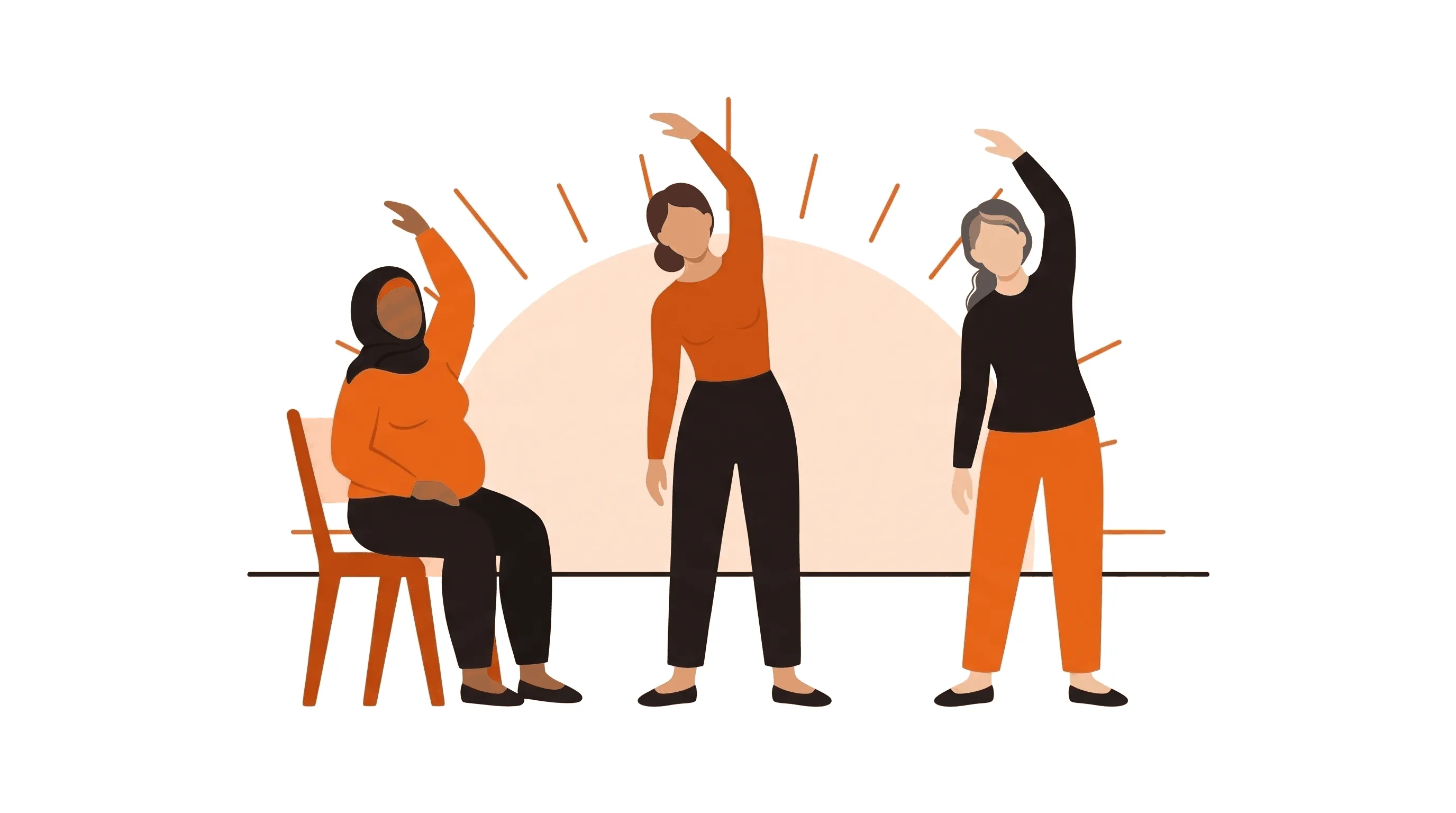
- Sit down, or hold on to a wall or a chair. Most exercises have a seated way.
- Each exercise card shows an easier way and a harder way.
- Use the talk test: you should be able to talk while you move.
- If you have a health problem, first read who should talk to a health professional.
Fit your culture and your life
- Wear what you feel comfortable in. The exercises work in everyday clothes.
- Move at home, alone or with other women, if that feels better.
- Choose your own music, or no music. You can count or clap instead.
- Pick a time that fits around prayer, school and work. If you fast, read being active while you fast.
- Use the dances you already know. See culturally relevant movement.
- You never have to hold hands or touch anyone.
Fit what you have
- No equipment: use a chair without wheels, a wall or water bottles.
- Little space: choose seated exercises or exercises next to a wall.
- Little time: a few minutes count. Try 5 minutes before a meal.
- Free places: parks, community centres and free outdoor fitness areas.
- In winter, move indoors: march on the spot or dance at home.
Part 2 of 3
Feedback mechanism
Tell us what works for you and what does not. Your answers help us improve the toolkit and make it fit women from different cultures.
Do not write your name or anything about your health. You send your answers by email to info@furim.no.
FURIM, the organisation that leads VITALITY, will see your email address. Only FURIM staff read the emails. Your answers are used only to improve the toolkit.
FURIM keeps your answers without your name or email address. Then it deletes your email, within one month. Before you send, you tick a box to say you understand this.
You do not have to send an email. You can give a paper form without your name to the person who runs your group.
This website does not keep your answers.
Part 3 of 3
Facilitator guide
Are you a community leader or a volunteer? Would you like to bring a small group of women together to move? The facilitator guide explains how.
It covers:
asking the women what they want
choosing a place and a time that work for them
keeping everyone safe
privacy, photos and consent
a session plan you can use every week
starting something local that lasts
Sources for this module
- IFRC Reference Centre for Psychosocial Support and partners. Moving Together: Promoting psychosocial well-being through sport and physical activity. 2014. (opens in a new tab)
- Gagliardi AR, Morrison C, Anderson NN. The design and impact of culturally-safe community-based physical activity promotion for immigrant women: descriptive review. BMC Public Health 2022;22:430. (opens in a new tab)
- Zou P, et al. Factors influencing physical activity participation among midlife immigrant women: a systematic review. Int J Environ Res Public Health 2021;18(11):5590. (opens in a new tab)
- Batalha et al. Barriers and facilitators to physical activity among ethnic minority women: a systematic review. BMC Women's Health 2025;25:330. (opens in a new tab)
- Women in Sport. Insight Pack: Muslim Women and Girls. December 2019. (opens in a new tab)
- ISCA. Implementation Guide for Integration of Refugees Through Sport. Copenhagen; 2018. (opens in a new tab)
- UNHCR, International Olympic Committee, Terre des hommes. Sport for Protection Toolkit: Programming with Young People in Forced Displacement Settings. 2018. (opens in a new tab)
- World Health Organization. WHO guidelines on physical activity and sedentary behaviour. Geneva: WHO; 2020. ISBN 978-92-4-001512-8. (opens in a new tab)
- Ministerstwo Sportu i Turystyki (Poland). Start rządowego programu budowy Otwartych Stref Aktywności (OSA). 2018. (opens in a new tab)